

(Kitco NewsWire) – Spot gold and silver prices were higher in early U.S. trading Monday, recovering from Friday's sharp losses as renewed diplomatic efforts involving Iran and the United States pushed crude oil prices lower and eased some inflation concerns ahead of a busy week of U.S. economic releases and midterm elections. Gold found support from perceived bargain hunting and declining Treasury yields after suffering its worst monthly performance since 2008, while silver rebounded more strongly following heavy liquidation across precious metals and technology shares. Spot gold was trading near $3,945.70 an ounce, up $67.90, or 1.80%, while spot silver was trading near $50.940, up $1.810, or 3.66%.
Market positioning remains focused on the possibility of additional Federal Reserve tightening in December following last week's decision to leave the benchmark federal funds target range unchanged at 3.75% to 4.00%. Interest rate futures continue to indicate a substantial probability of another increase before year-end, with the latest available estimates placing the likelihood near 75%. Strong economic growth and persistent underlying inflation support the case for additional tightening, while moderating employment costs, weaker manufacturing momentum and Friday's sharp equity-market selloff provide counterarguments. Lower yields, a softer dollar and declining crude oil prices provided a more favorable backdrop for gold, although the prospect of further rate increases continues to limit the conviction behind the recovery.
The Strait of Hormuz and U.S.-Iran situation remains a significant source of uncertainty in global energy markets, although fresh diplomatic developments have reduced immediate concerns about another major military escalation. Iran announced Monday that it could reopen the strategic waterway and resume nuclear negotiations with Washington within two days, shortening an earlier proposed seven-day timetable, provided the United States accepts conditions that include lifting the naval blockade of Iranian ports, easing sanctions on Iranian oil exports and agreeing to broader ceasefire arrangements. Tehran maintains that commercial vessels would transit through a route coordinated with Oman under Iranian supervision. However, Washington has not accepted the proposal, and substantial differences remain over sanctions relief, maritime security and the terms of any lasting settlement.
The announcement followed several days of negotiations involving Iranian and Qatari officials and a weekend that passed without the major military escalation some traders had feared. China also plans to send a special envoy to Iran, Oman and Saudi Arabia in early to mid-November to encourage regional de-escalation. Nevertheless, the underlying security situation remains fragile. Recent attacks on commercial vessels, continuing tensions involving Iranian-aligned Houthi forces and unresolved U.S.-Iran military threats leave the Strait of Hormuz exposed to further disruption. The reopening proposal offers a possible path toward restoring more normal tanker traffic, but the absence of a confirmed agreement means elevated insurance costs, shipping restrictions and a geopolitical risk premium are likely to remain important features of the energy market.
Crude oil prices declined more than 4% in early Monday dealings as the diplomatic developments reduced some of the immediate supply-risk premium following Friday's sharp rally. Brent crude fell toward $108.55 a barrel, while WTI retreated below $100.00. The decline provided some relief from concerns that elevated energy costs would reinforce inflation and force the Fed to tighten monetary policy further. For gold, lower crude prices, weaker Treasury yields and a softer dollar have encouraged bargain hunting following October's heavy liquidation. However, the unresolved Gulf confrontation continues to support defensive demand, while persistent inflation and the possibility of additional Fed tightening limit the metal's upside potential. Silver has benefited from the improvement in precious metals sentiment but remains particularly sensitive to industrial demand and broader risk appetite after suffering a substantially larger October decline.
Global equity markets were mixed to firmer before the U.S. open as lower crude oil prices provided some relief from inflation and corporate cost concerns. S&P 500 futures advanced approximately 0.5% in early dealings, recovering part of Friday's decline as investors reassessed the technology-sector selloff and positioned ahead of Tuesday's midterm elections. Asian and European investors continued to weigh the outlook for corporate earnings, artificial intelligence-related capital spending and restrictive monetary policy. The decline in energy prices provided support for some economically sensitive sectors, although concerns about technology valuations and the financial implications of elevated borrowing costs remained significant. Investors also face a busy week of economic releases that could reshape expectations for U.S. interest rates and the direction of global equity markets.
The key outside markets see Nymex WTI crude oil prices sharply lower and trading near $99.58 a barrel, while Brent crude was near $108.55. The U.S. dollar index was softer near 101.50, while the yield on the benchmark 10-year U.S. Treasury note was trading near the 4.93% area. (Kitco Global Index shows how much of today's gold move is the dollar versus the gold market itself.)
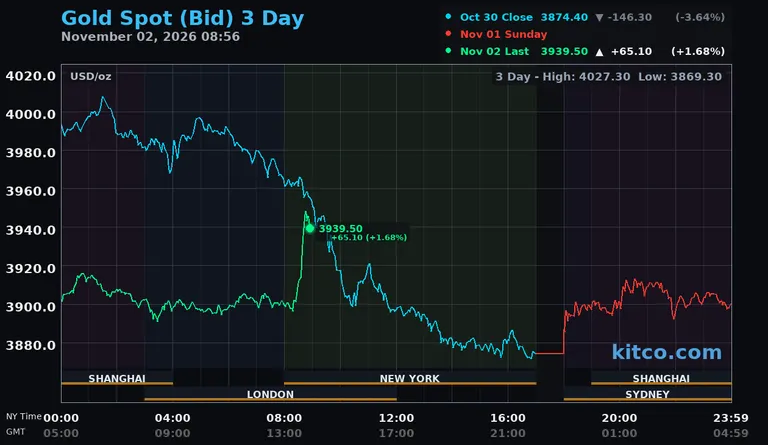
Technically, spot gold bulls' next upside price objective is to push prices back above the $3,978.00 to $4,035.00 resistance zone, with a sustained move targeting $4,086.00. Bears' next near-term downside price objective is a break below $3,817.00, with a deeper downside target at $3,719.00. First resistance is seen at $3,978.00 and then at $4,035.00. First support is seen at $3,817.00 and then at $3,719.00.
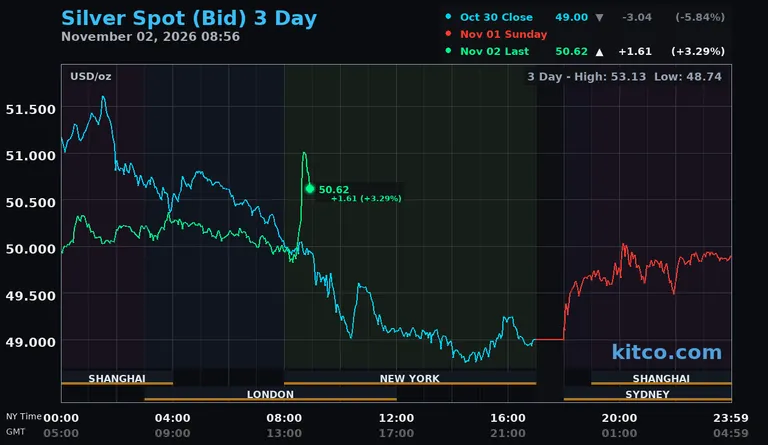
Spot silver bulls' next upside price objective is to drive prices back above the $54.720 to $59.000 resistance zone, with a sustained move targeting $61.000 and then $62.030. The next downside price objective for the bears is a break below $49.040, with a deeper downside target at $45.660. First resistance is seen at $54.720 and then at $59.000. Next support is seen at $49.040 and then at $45.660.
See live precious metals prices for gold, silver, platinum and palladium — in USD, CAD and 12 more currencies.

