
(Kitco News) - Gold prices continue to struggle as persistent inflation and rising interest rates drive investors toward higher-yielding assets; however, one precious metals analyst says the market is consolidating rather than entering a bear market, with the structural drivers that supported last year's historic rally remaining firmly intact.
In an interview with Kitco News, Matthew Piggott, Director of Gold and Silver at Metals Focus, said that although investors have become increasingly cautious, institutional and central bank buying continues to support gold above $4,000 an ounce.
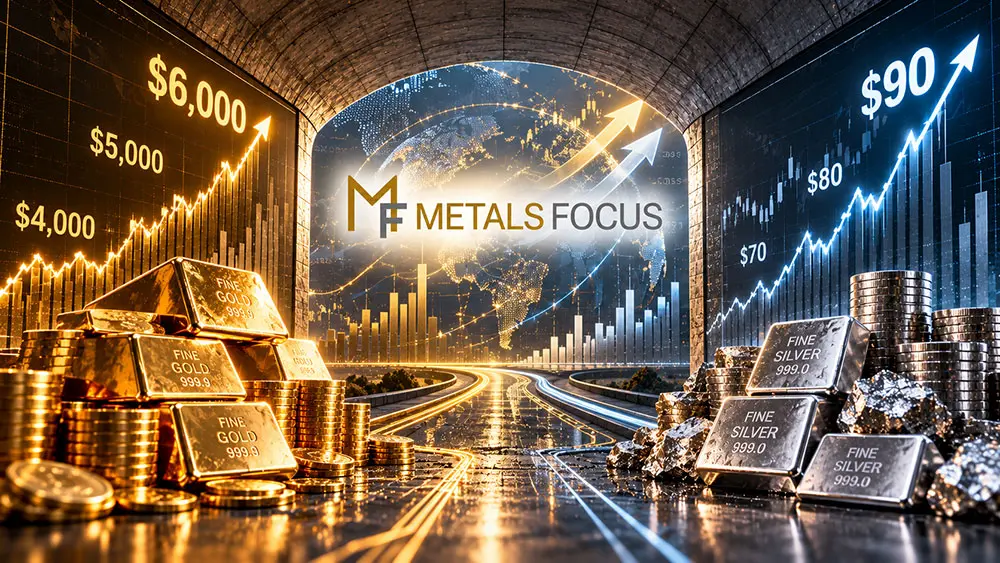
His comments come as Metals Focus forecasts gold prices will average $5,330 an ounce in 2027, a 16% increase from this year's projected average of $4,600. The British research firm expects gold to average $5,600 in the fourth quarter of next year, with prices potentially approaching $6,000.
At the same time, Metals Focus expects silver to regain its investment appeal, with prices averaging $84.40 an ounce next year and rising above $90 in the fourth quarter.
Piggott explained that gold's inability to sustain a rally since its correction earlier this year reflects competition for investment capital rather than a fundamental deterioration in the precious metal's long-term outlook.
Investors have increasingly focused on opportunities in equities, cryptocurrencies, energy and other commodities, while elevated bond yields have increased the opportunity cost of holding non-yielding assets.
However, Piggott noted that institutional investors have consistently returned to the gold market when prices have fallen toward $4,000 an ounce.
"So we've had kind of a floor established, and central banks have been a big part of that too," he said.
Piggott added that the underlying economic and geopolitical factors that supported gold's rally in 2025 have not disappeared. If anything, he argued, growing government debt and fiscal uncertainty have strengthened the longer-term investment case.
The challenge is that these structural drivers have been overshadowed by more immediate concerns about inflation, energy prices and monetary policy.
Piggott explained that concerns about de-dollarization, government debt and fiscal sustainability remain important reasons for institutional investors to hold gold, even as speculative interest has weakened.
The Metal Focus report reinforces that outlook, noting that large government deficits, rising debt-servicing costs and uncertainty surrounding U.S. economic policy should continue encouraging diversification away from traditional dollar-denominated assets.
The analysts also expect central banks to remain substantial net buyers of gold in 2027, even though official-sector purchases have moderated from the exceptional levels seen between 2022 and 2024.
Despite his bullish longer-term outlook, Piggott said the ongoing conflict in the Middle East remains a significant obstacle to renewed investment demand.
He explained that elevated energy prices have created a complicated environment for precious metals by driving inflation higher, strengthening the U.S. dollar and reinforcing expectations that central banks will maintain restrictive monetary policies.
Although higher inflation can theoretically support gold when it reduces real interest rates, Piggott noted that the relationship becomes more complicated when rising energy prices simultaneously support the dollar.
He said investors will need to see tangible progress toward resolving the Middle East conflict before becoming more confident about buying gold and silver during rallies rather than simply purchasing price dips.
"To remove that pressure of inflation, you've got to see something give on the energy side and for things to calm down on the energy side," he said.
Piggott added that even temporary progress toward negotiations could improve sentiment, although investors have become increasingly skeptical of diplomatic announcements that fail to produce lasting changes.
The risk, he warned, is that the conflict could escalate again following the U.S. midterm elections, prolonging energy-driven inflation and keeping monetary policy expectations elevated.
Nevertheless, Metals Focus does not expect the Federal Reserve to embark on a prolonged tightening cycle. The consultancy argues that aggressive rate hikes would increase the risk of a sharper economic slowdown, eventually reinforcing demand for gold as a portfolio diversifier.
Piggott said Metals Focus continues to expect gold's rally to resume in the fourth quarter, although the timing has been pushed back as the Middle East conflict has dragged on.
"The way our price forecast has evolved is we've been pushing the rally resumption back as the conflict has extended and carried on," he said.
He added that the precious metal's resilience is particularly noteworthy given how dramatically the monetary policy outlook has changed.
"The bottom hasn't fallen out of gold, even though we have swung from a position of expecting multiple rate cuts to multiple rate hikes," he said.
Beyond an improvement in geopolitical sentiment, Piggott expects seasonal physical demand to provide additional support through the final months of the year.
He noted that retail investment demand for gold and silver bars and coins has been relatively subdued since the initial surge in January, with substantial selling back to dealers offsetting new purchases.
However, he expects seasonal buying in markets such as China and India to help improve physical investment demand.
Silver's rally to $90 will depend on investors, not industrial demand
While gold's outlook remains supported by central bank purchases and concerns about fiscal sustainability, Piggott said silver faces a more complicated fundamental environment.
Metals Focus expects silver prices to average $84.40 an ounce in 2027, a 16% increase from this year's projected average of $72.60, with prices rising above $90 in the fourth quarter of next year.
However, the consultancy forecasts that silver's physical market will shift from a deficit of 35.4 million ounces this year to a surplus of 37.3 million ounces in 2027.
The expected improvement in supply comes as elevated prices encourage industrial users to reduce their consumption of silver, particularly in the photovoltaic sector.
Piggott explained that manufacturers have been steadily reducing the amount of silver required to produce solar panels, a trend that began well before prices reached their record highs earlier this year.
He said the industry's efforts to reduce silver consumption are not solely driven by the metal's price but also reflect manufacturers' ongoing attempts to improve efficiency and reduce production costs.
Although higher prices accelerated research into alternative materials, including copper, Piggott said the industry is continuing to make incremental improvements to existing manufacturing processes.
Metals Focus expects industrial silver demand to decline to 618.2 million ounces in 2027, down from 640.2 million ounces this year.
More importantly, Piggott said Metals Focus believes the solar industry has passed a critical threshold at which improvements in silver efficiency are expected to outweigh growth in solar installations.
"We've already passed the inflection point," he said.
He explained that even if solar installations grow faster than currently projected, the continued reduction in silver used per panel should lead to declining consumption in the photovoltaic sector.
That outlook does not depend on an unproven technological breakthrough or the widespread replacement of silver with copper.
"This is just the core of thrifting of existing technologies one year after the next," he said.
Piggott added that growing silver consumption in electric vehicles, data centers and other industrial applications should help offset some of the decline in photovoltaic demand, but he does not expect those sectors to fully compensate for the losses over the next 12 months.
Despite these industrial headwinds, he said the silver market is not facing an overwhelming physical surplus.
Instead, he expects renewed investor participation to become the primary driver of higher silver prices.
"Silver demand is based around the investment side," he said. "If you're not seeing a rally in gold concurrently at that time, I don't think you're going to see silver have any kind of fireworks whatsoever."
Piggott explained that a sustained silver rally would likely require stronger inflows into silver-backed exchange-traded products, which would remove available metal from the market and potentially tighten liquidity.
He noted that the historic rally earlier this year was partly driven by tightening London inventories and localized physical shortages, particularly in India.
However, he does not expect the market to experience the same extreme physical conditions that previously pushed silver above $120 an ounce.
Instead, the next rally is likely to be driven by renewed investment momentum as investors return to precious metals in response to fiscal uncertainty, geopolitical risks and a stronger gold market.
Although industrial demand is expected to decline, Piggott rejected the idea that silver's investment appeal depends entirely on its reputation as a cheaper alternative to gold.
He explained that the growing availability of exchange-traded products and fractional investment opportunities allows investors to gain exposure to gold without having to purchase an entire ounce or physical coin.
As a result, silver's appeal increasingly depends on its own investment characteristics and its dual role as both a precious and industrial metal.
"I think the argument of silver being poor man's gold falls away slightly, and it more becomes one of silver becoming a parallel precious metal to gold," he said.
Piggott noted that investors can approach silver from different perspectives, depending on whether they are optimistic about industrial consumption or primarily interested in precious metals as portfolio diversifiers.
He also emphasized that physical investment demand remains relatively healthy in important markets such as India, despite declining from last year's exceptional levels.
Metals Focus expects Indian physical silver investment to fall by approximately 10% this year, but Piggott said that decline needs to be viewed against the extraordinarily strong buying seen in the second half of 2025.
"We've come down from exceptionally strong levels to quite strong levels of investment in India," he said. "So the number says 10% down, but it's not weakness."
See live precious metals prices for gold, silver, platinum and palladium — in USD, CAD and 12 more currencies.

