
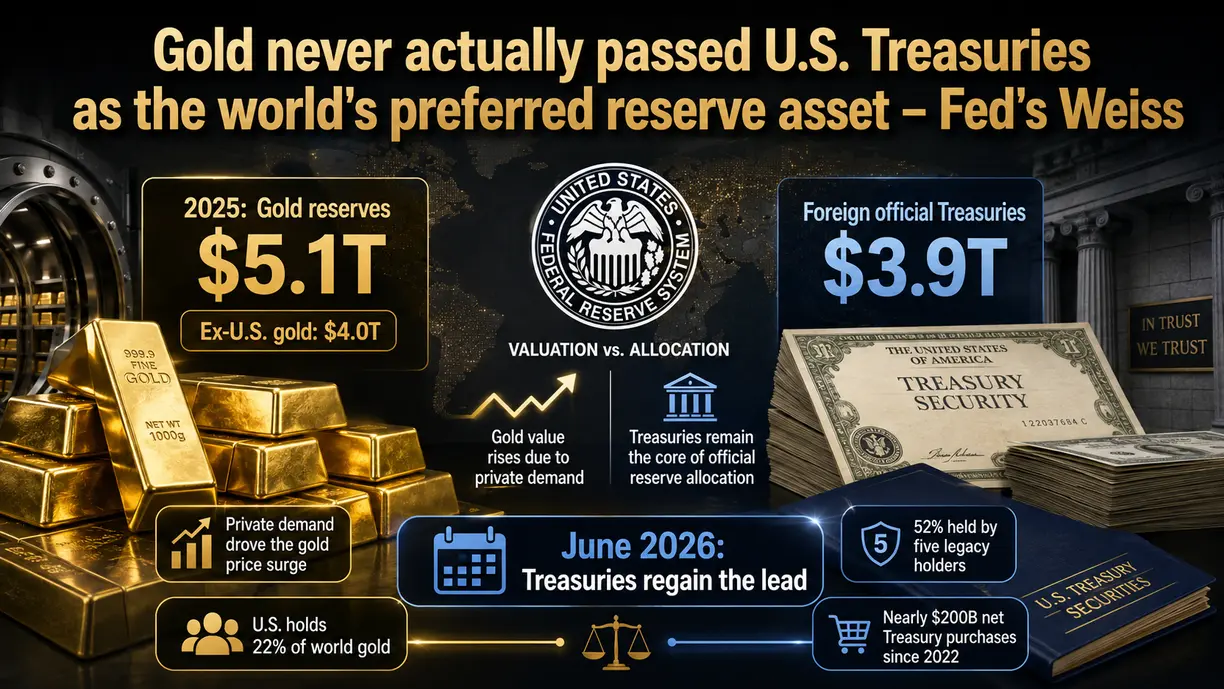
(Kitco News) – Even though central banks have been ramping up their bullion purchases in recent years, a simple comparison of the value of U.S. treasuries and gold in countries’ official reserves is misleading, as gold’s price appreciation has been driven largely by private demand, while most official gold reserves are still held by countries that haven’t purchased any in over 50 years, according to Colin Weiss, Principal Economist for Global Financial Flows at the Federal Reserve.
“In 2025, world international reserves held in gold surpassed foreign official holdings of U.S. Treasury securities, a fact drawing attention from media and policymakers,” Weiss wrote in a Federal Reserve research note on Thursday. “Should this be interpreted as gold overtaking U.S. Treasury securities in its appeal as a reserve asset?”
Weiss believes this is not the case, offering several reasons why “a comparison of world gold reserves and aggregate foreign official holdings of U.S. Treasury securities is problematic.”
“First, the rise in the market value of gold reserves since 2024 was primarily driven by a surge in gold prices from a jump in private sector demand,” he argues. “Second, the rise in the share of gold in global reserves is mostly accounted for by a handful of countries with large legacy holdings from the Bretton Woods era that have not accumulated gold in any meaningful amount since the 1970s—including the U.S., which cannot hold Treasury securities as international reserves.”

Weiss writes that the dramatic increase in the market value of countries’ gold reserves since 2024 was fueled primarily by a sharp rise in private sector demand, which had the effect of boosting gold prices.
“This surge in gold prices does not reflect a concurrent spike in central bank purchases,” he said. “While central bank purchases of gold likely increased substantially in 2022, these banks have only maintained that elevated pace since then. Rather, demand from private sector investors jumped in late 2024, manifesting in inflows to physical gold-backed exchange traded funds.”

“Thus, while the spectacular rise in gold prices witnessed in 2025 likely required strong demand from both private and official investors, the demand from official investors in isolation would not have been sufficient to cause a surge in prices.”
Weiss also analyzes the impact of including and excluding the United States’ own massive gold reserves in these calculations.
“Foreign official holdings of U.S. Treasury securities by definition exclude the Federal Reserve as a holder, but the series for world gold reserves includes those held by the U.S. government,” he writes. “The U.S. is the largest holder of gold reserves, accounting for 22 percent of the world total, leading to world gold reserves substantially overstating gold's importance relative to U.S. Treasury securities in foreign governments' reserve portfolios.”
“Excluding U.S. gold reserve holdings, world gold reserves were $0.8-$1.1 trillion below the headline gold reserve number throughout much of 2025 (red line in figure 1).”
Weiss acknowledges that by the end of 2025, world gold reserves stood at $5.1 trillion, and even excluding the U.S., they totaled $4 trillion – still greater than the $3.9 trillion of foreign official holdings of U.S. Treasury securities. “Again, though, this largely reflects large valuation changes rather than any sharp uptick in central bank accumulation over the past 18 months,” he notes. “By June 2026, foreign official holdings of Treasuries again surpassed world gold reserves excluding the U.S. in dollar terms despite further increases in gold reserves as measured in fine troy ounces.”
Weiss characterizes the overwhelming majority of the world’s central bank gold reserves not as a deliberate and strategic decision to diversify away from the U.S. dollar, but as an accidental relic of the Bretton Woods era.
“Despite accumulation by many emerging market central banks beginning in 2008, most world gold reserves were still acquired prior to 1971, which was the de facto end of the Bretton Woods system,” he notes. “By contrast, most foreign official holdings of Treasuries were accumulated after 2000. Moreover, the set of countries holding large gold reserves is often distinct from the set of countries holding large foreign exchange reserves.”
Weiss points out that the countries in 2026 who are “actively choosing between holding reserves in gold or U.S. Treasury securities” still account for a small share of world gold reserves.
“The five largest holders of gold reserves—the U.S., Germany, Italy, France, and the IMF—account for about 52 percent of current world gold reserves but have not accumulated gold in any meaningful amount since the 1970s,” he writes. “Moreover, the U.S., Germany, France, and Italy have not accumulated substantial foreign exchange reserves either, so gold now, at its current market price, accounts for more than 80 percent of international reserves in each country.”
And looking beyond the big five holders of gold reserves, Weiss points out that treasuries remain a larger part of international reserve portfolios than gold.

“Foreign official holdings of Treasury securities were around $1 trillion larger than gold reserves in June 2026, despite the valuation-driven narrowing of the gap over the past year,” he writes. “This comparison could overstate or understate the gap, however. On the one hand, there may be substantial official sector purchases of gold after 2021 not reported in the official statistics published by the IMF. On the other hand, true foreign official holdings of U.S. Treasury securities are likely larger than what is reported in the TIC data as well, due to some official investors' use of non-U.S. custodians for part of their holdings of Treasury securities.”
“Even accounting for just the additional official sector purchases estimated by the World Gold Council beginning in 2022, foreign official sector holdings of U.S. Treasury securities outside the U.S., Germany, France, Italy, and the IMF, exceeded official sector gold holdings by about $0.6 trillion,” he added.
Weiss argues that comparing foreign official holdings of treasuries to gold reserves understates the importance of Treasury securities in these reserves due to the valuation effects that were largely driven by private sector demand, and the massive legacy gold holdings of a handful of countries.
“Nevertheless, official sector investors have been accumulating gold on net since 2008, and the pace of this accumulation likely increased significantly beginning in 2022,” he says. “These purchases could partly reflect geopolitical considerations, such as ideological proximity to the U.S. or financial sanctions. Still, despite several major holders of foreign exchange reserves selling hundreds of billions of dollars of reserves to support their currencies after 2021, foreign official investors have purchased nearly $200 billion of U.S. Treasury securities on net from 2022 through April 2026. Treasury securities thus remain an important part of reserve portfolios.”
See live precious metals prices for gold, silver, platinum and palladium — in USD, CAD and 12 more currencies.
