
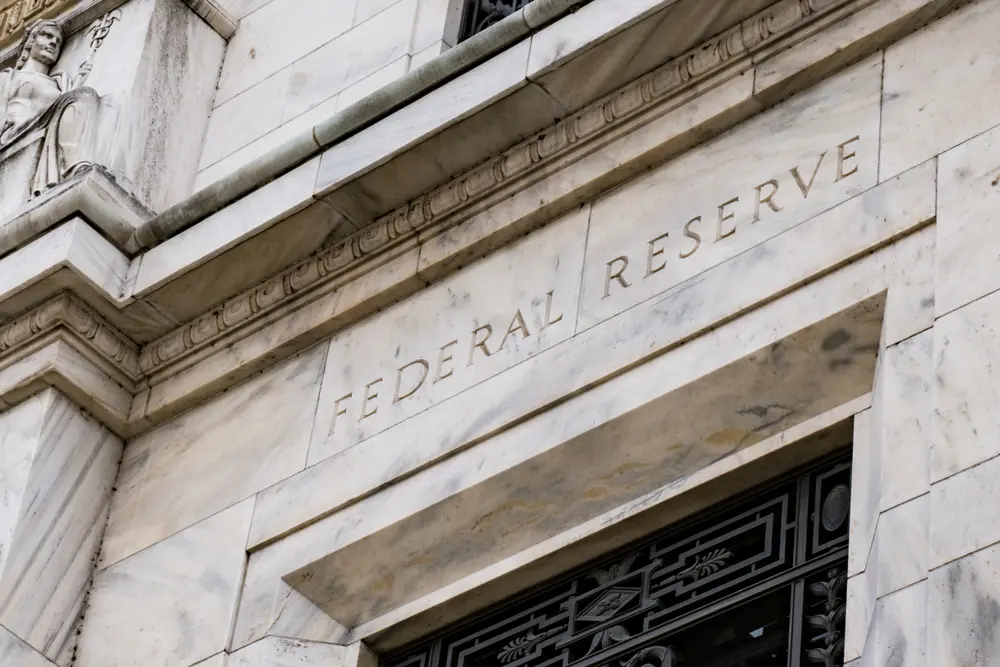
(Kitco News) - The gold market is seeing significant selling pressure as Federal Reserve Chair Kevin Warsh reiterates his commitment to bringing inflationary pressures back in line with the central bank’s 2% target.
Friday, in his much-anticipated speech at the annual Central Bank Symposium in Jackson Hole, Wyoming, Warsh said that the price-stability side of the Federal Reserve’s mandate is more of a concern than the slowing labor market.
“There are always areas of concern in the labor market—for example, among recent graduates. In general, though, people who want to work, by and large, are holding or finding jobs. They may well be concerned about possible future labor disruptions, but as of now, I believe the labor markets are consistent with full employment,” Warsh said in his speech. “But on the price-stability side of our mandate, the numbers are more concerning. The Fed's preferred measure of inflation, the 12-month change in the PCE price index, stands at 3.7 percent, while the six-month change is 4.1 percent.”
“We must be confident that underlying inflation is moving to our objective, clearly and at sufficient speed. Otherwise, we have work to do. That's our job . . . our mandate . . . and our charge to keep,” he added.
Although Warsh provided no forward guidance on U.S. monetary policy, analysts noted that his focus on inflation suggests a tightening bias. Adam Button, Chief Currency Analyst and Managing Editor at investingLive.com, said that Warsh’s comments signal that he is leaning toward a rate hike.
The gold market is seeing solid selling pressure in its initial reaction to Warsh’s comments. Prices have dropped well below $4,600 an ounce as markets once again start to price in a potential rate hike as early as next month.
Spot gold last traded at $4,552.00 an ounce, down more than 1% on the day.
Along with his optimistic views on the labor market, Warsh also struck a positive note on economic activity.
“Certain sectors—like housing and agriculture—are showing strains. But, on balance, I would be hard pressed to describe broad financial conditions as restrictive,” he said. “Real consumer spending has been healthy despite the shocks, increasing more than 2 percent over the past four quarters.”
Jeffrey Roach, Chief Economist for LPL Financial, said that Warsh’s comments reinforced expectations that the central bank will maintain its tightening bias in an environment of shifting economic priorities.
“We are entering a new era of monetary policy, one defined by less signaling, greater emphasis on real-time data, and a willingness to rethink economic first principles as AI reshapes the economy's productive capacity. The distinctly hawkish speech gave support to the dollar as the chairman appears comfortable keeping policy higher for longer,” he said.
