
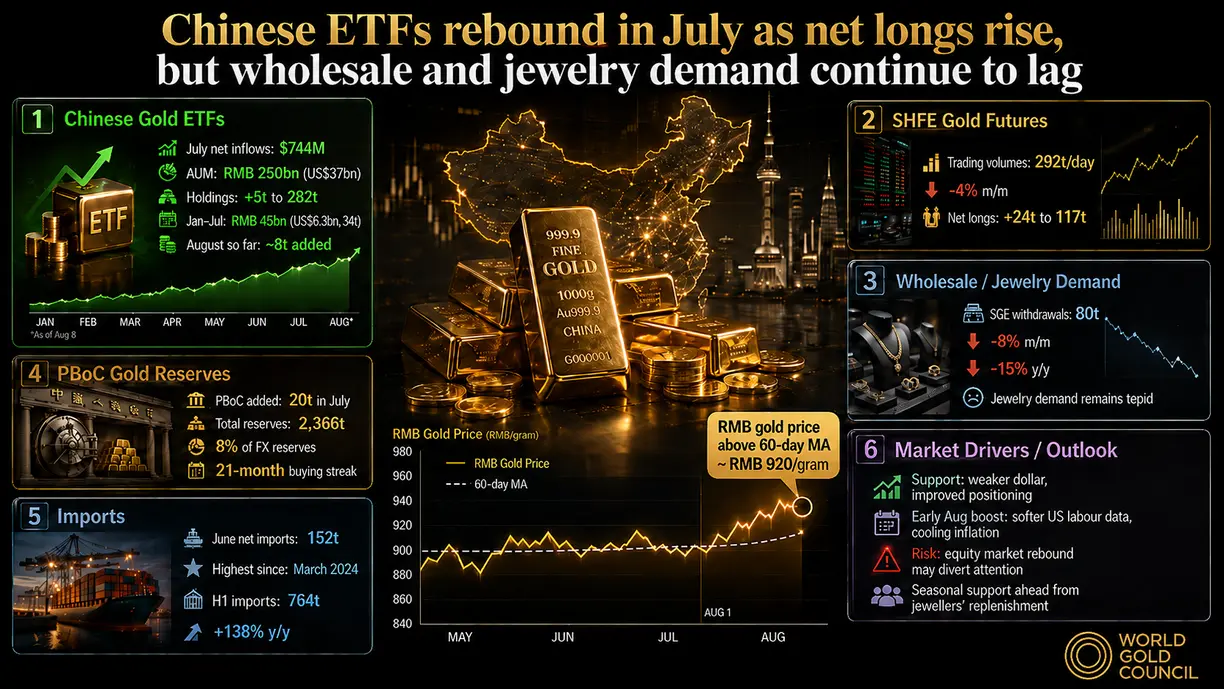
(Kitco News) – As gold’s price volatility declined last month, Chinese futures trading volumes cooled but net longs rose, while the country’s gold ETFs recorded positive flows which have continued into August, according to Ray Jia, research head for China at the World Gold Council (WGC).
In the WGC’s latest China gold market update, Jia noted that both the LBMA and Shanghai gold prices were virtually unchanged in July.
“Our gold return attribution model shows that a weaker dollar and improved investor positioning supported gold, offsetting pressure from rising yields,” he said. “And in early August, gold rose higher on softer US labour market data and cooling inflation, which delayed expectations of rate hikes from the Fed; the RMB gold price rallied above its 60-day moving average of around RMB920/gram for the first time since mid-March.”

Meanwhile, Chinese gold ETFs saw $744 million in net inflows in July, following the significant outflows seen over the previous months. “Healthy inflows lifted Chinese gold ETFs’ total AUM by 3% to RMB 250bn (US$37bn),” Jia wrote. “In tonnage terms, holdings increased 5t to 282t. In July, investor interest was buoyed by recurring geopolitical uncertainty, weaker equities and persistent gold accumulation by the PBoC. Meanwhile, rising institutional investor participation as the gold price stabilised also supported demand in the month.
“Despite outflows in May and June, Chinese gold ETFs attracted RMB45bn (US$6.3bn, 34t) between January and July, the second strongest y-t-d performance on record,” he added, pointing to increased institutional participation and higher allocations. “And it is worth noting that so far in August, Chinese gold ETFs have added ~8t with inflows seen almost every day in the month, mainly supported by the strong gold price momentum.”

And while gold futures volumes were down last month, net longs were up.
“Gold futures trading volumes on the SHFE further moderated in July, falling 4% m/m to 292t/day,” Jia said. “Trading activity cooled slightly as gold price volatility declined. Top 20 gold futures participants’ net longs – due to data limitation – at the SHFE rose 24t to 117t by the end of July, reflecting improved market sentiment.”
Wholesale demand, however, remained tepid last month as jewelry sector weakness combined with the seasonal lull.
“Wholesale gold demand, as measured by SGE withdrawals by banks, jewellers and refiners, fell 8% m/m to 80t in July,” he noted. “The decline was largely seasonal, as the jewellery sector is typically tepid in Q2 and early Q3. Industry feedback also suggests that investment demand was broadly unchanged from June and therefore failed to offset softer jewellery-related buying.”

“On a y/y basis, SGE withdrawals were down 15%, reflecting subdued jewellery consumption amid higher gold prices than a year ago and still-weak consumer confidence.”
Meanwhile, the People’s Bank of China continued its torrid pace of gold accumulation with a 20-tonne addition to its gold reserves in July, bringing official gold holdings to 2,366 tonnes, or 8% of total foreign exchange reserves.

“Following the largest monthly addition since October 2023, the PBoC’s gold-buying streak has now reached 21 months, the longest on record,” Jia pointed out. “The central bank continued to accelerate its buying, likely taking advantages of a lower gold price and underscoring gold’s strategic role in reserve diversification amid an increasingly fragmented geopolitical landscape.”
And Chinese imports also rose in June – the most recent period for which data are available – with the country’s net gold imports totaling 152 tonnes during the month, an uptick of 2 tonnes compared to May and the highest monthly level since March 2024.

“Over the course of H1 China imported 764t of gold, 138% higher y/y, reflecting strong investment buying during the period,” he added.
Looking ahead, Jia said that if the gold price continues to make gains, Chinese investment demand may follow. “However, the domestic equity market rebound in early August – should it persist – could divert attention,” he said. “Wholesale gold demand could receive seasonal support from a rise in jewellers’ inventory replenishment ahead.”
