
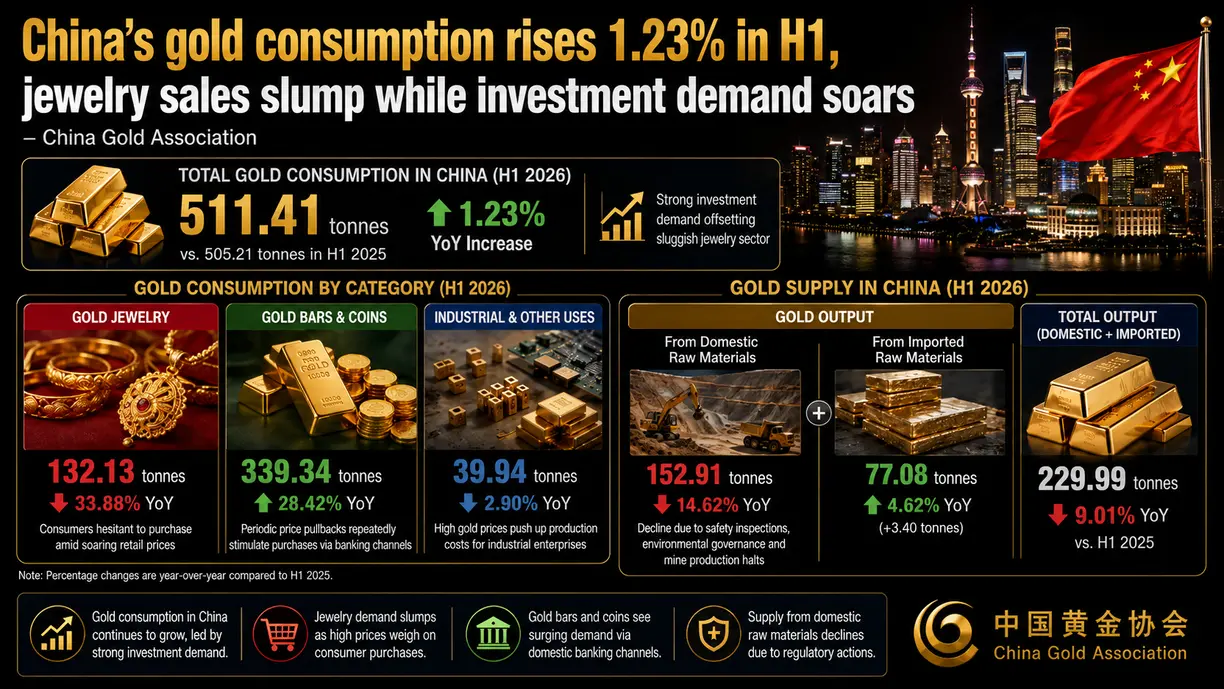
(Kitco News) – China’s total gold consumption rose 1.23% in the first half of 2026, according to the latest data from the China Gold Association (CGA).
Gold consumption in China came in at 511.41 tonnes in the first six months of the year, the CGA said, compared to 505.21 tonnes in H1 2025, with strong investment demand offsetting the still-sluggish jewelry sector.
The association noted that the country's gold consumption patterns were in flux, as the combination of sharp price fluctuations above historically high levels and newly-implemented domestic gold tax policies impacted consumer purchasing habits.
The impacts were most pronounced in jewelry and in investment, though for opposite reasons. Demand for gold jewelry plummeted 33.88% year-over-year to 132.13 tonnes, with consumers hesitant to make purchases amid soaring retail prices. On the other hand, burgeoning investment demand saw the consumption of gold bars and coins to 339.34 tonnes, an increase of 28.42%.
The CGA said the periodic price pullbacks have served to repeatedly stimulate purchases of gold bars through domestic banking channels, even as persistently high gold prices have pushed up production costs for industrial enterprises, contributing to a 2.9% decline in industrial and other gold uses, which totaled 39.94% tonnes for the first six months of 2026.
On the supply side, China's gold output from domestic raw materials dropped 14.62% year-over-year to 152.91 tonnes. The CGA attributed the decline to comprehensive safety inspections, rectifications and special environmental governance campaigns in key gold-producing provinces, which led to temporary production halts at some major gold mines.
Gold produced from imported raw materials, however, rose 4.62% or 3.40 tonnes to 77.08 tonnes in H1. China produced a combined 229.99 tonnes of gold from both domestic and imported raw materials, a 9.01% decrease compared to the same period in 2025.
In a recent interview with Kitco News, Willem Middelkoop, founder of the Commodity Discovery Fund and author of ‘The Big Reset’, said the government of China actually favors a lower gold price right now because it is still buying, and that the monetary "reset" he has forecast for over a decade is no longer a prediction but a process already underway.
"A monetary reset is a more gradual process. It's not a binary event," Middelkoop said. "We're in the first innings."
"China is a very active buyer of dips," Middelkoop said, adding that the same pattern holds in copper and oil.
Asked about Chinese banks pulling retail access to the Shanghai Gold Exchange, Middelkoop said he read the move as China steering savers away from paper trading and toward physical metal, not as a crackdown. He said China has long run a dual strategy, citing a program he called "Storing Gold with the People" that he said appears in a Chinese publication from 2011 or 2012. "China understands it's all about owning the physical stuff in the end," he said.
Major Chinese lenders including ICBC halted retail Shanghai Gold Exchange trading after the July 24 settlement, covering both spot and deferred contracts, according to bank notices and Chinese financial press.
See live precious metals prices for gold, silver, platinum and palladium — in USD, CAD and 12 more currencies.
