
(Kitco News) – Sovereign demand for gold shot higher in May, with central bank purchases reaching the second-highest level of the year, surpassed only to February’s outsized performance, according to the latest data from Marissa Salim, Senior Research Lead, APAC at the World Gold Council.
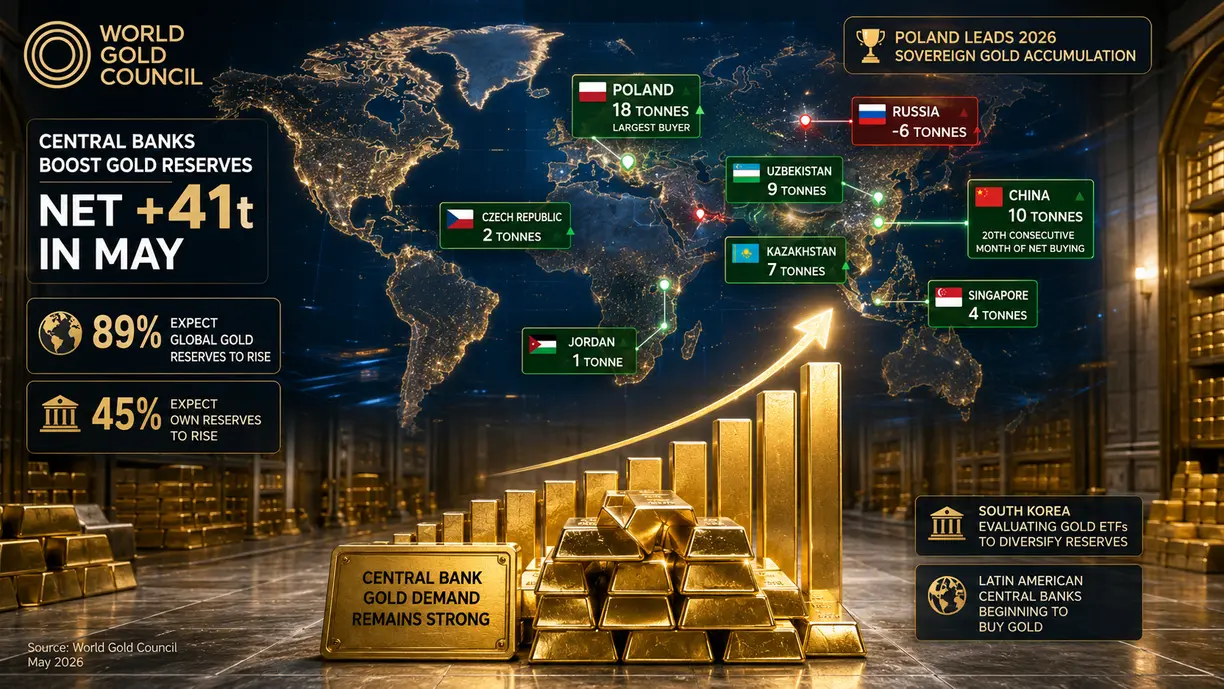
“Central banks were back in buying mode in May – and with a little more spring in their step,” Salim wrote on Thursday. “Based on the latest reported data, official gold reserves increased by a net 41t during the month, with purchases once again concentrated among a familiar cast of buyers.”

The biggest buyers were Poland, with 18 tonnes, and China with 10 tonnes, while Uzbekistan and Kazakhstan also continuing their recent streak of gold purchases. “Singapore also rejoined the list of buyers, reporting a net purchase of 4t, its first monthly net purchase since September 2025,” Salim noted. “Meanwhile, net sellers for the month were Turkey (3t) and Russia (6t) with y-t-d sales of 81t and 34t respectively.”
Poland also leads all sovereign buyers in annual terms, having accumulated 64 tonnes of gold in 2026, followed by Uzbekistan’s 33 tonnes, China’s 25 tonnes, and Kazakhstan’s 20 tonnes.
Salim also pointed out that despite gold’s precipitous price decline since the start of the Iran war, central bankers remained favorable to increasing the gold in their reserves. “As published in our ninth Central Bank Gold Reserves Survey 2026, 89% of central bankers expect global gold reserves to increase in the next 12 months,” she wrote. “Meanwhile, a record high 45% of central bankers expect their own institution’s gold reserves to increase over the next 12 months.”

Drilling down into the details of the data, Salim noted May was Poland’s its fourth straight month of double-digit net buying – with 64 tonnes purchased since February – and its highest monthly total since February. “Poland now holds 614t of gold in its reserves, inching closer to its 700t target,” she said.
Meanwhile, China’s 10-tonne purchase was the highest monthly addition since December 2024, and represented its 20th consecutive month of net buying. “Y-t-d, China has added 25t to its gold reserves and is among the top three accumulators so far this year,” Salim said. “China’s official gold reserves now stand at 9% of total reserves or around 2,331t.”
The Central Bank of Uzbekistan bought 9 tonnes in May, with year-to-date purchases now totaling 33 tonnes, second only to Poland. “Uzbekistan’s gold reserves now stands at 87% of its total reserves,” she said. “The National Bank of Kazakhstan bought 7t in the month; y-t-d it has bought a net 20t. Kazakhstan’s official gold reserves stand at 361t or 78% of its total reserves.”
Singapore, which purchased 4 tonnes for its first monthly net purchase since September 2025, raised its total gold holdings to 197 tonnes. “Separately, the MAS is looking to establish central bank gold vaulting services October 2026, in line with the country’s plans to establish a gold hub in the city state,” Salim noted.
Other significant sovereign purchasers included the Czech National Bank and the Central Bank of Jordan, which bought 2 tonnes and 1 tonne respectively.
On the selling side, the Central Bank of Russia continued its streak of net selling in May with 6 tonnes of gold liquidated. “Y-t-d, Russia has sold 34t of gold, lowering its total gold holdings to 2,292t,” she wrote.
The Central Bank of the Republic of Turkey also sold 3 tonnes of gold this month, bringing its year-to-date sales to 81 tonnes.

Meanwhile, South Korea is readying a significant allocation to gold ETFs.
“The Bank of Korea has reportedly completed preparations to invest in overseas gold-backed ETFs as part of its strategy of foreign currency asset diversification, although due to its confidentiality policy there has been no indication as to whether the allocation has been made,” Salim said. “According to the report, gold-backed ETFs were the instrument of choice due to their high liquidity and lower storage costs.”
“The bank currently holds 104t of gold in its reserves – about 3% of its total reserves – a figure that is relatively low compared to its emerging market peers,” she added. “Gaining exposure to gold via ETFs is fairly uncommon amongst central banks: only 4% of survey respondents indicated that they purchase gold via gold-backed ETFs.”

And the yellow metal is also gaining traction with the central banks of Latin America.
“Over the course of 2026, our analysis has picked up new gold buying activity within Latin American central banks,” Salim wrote. “Chile has accumulated around 8t of gold y-t-d, followed by Guatemala (2t), and Bolivia and Uruguay at 1t each. While this region has seen some geopolitical heat recently, it is too early to tell if this trend will gain traction or broaden out to match other Latin American peers.”

