
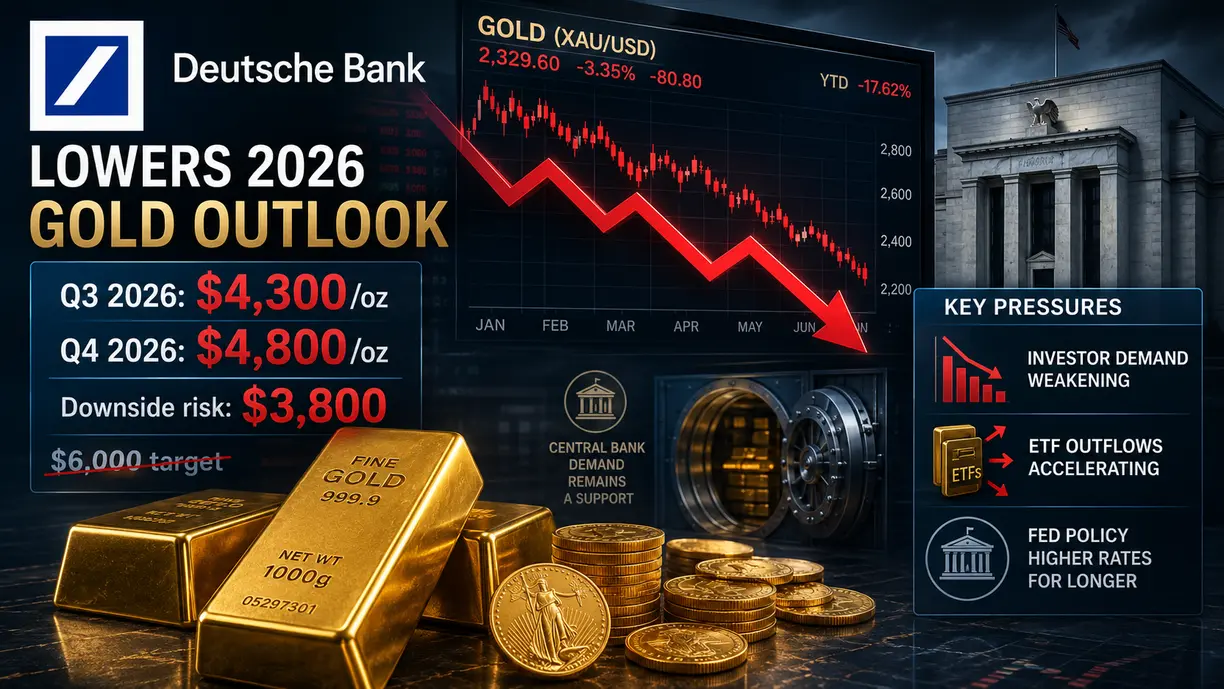
(Kitco News) – Demand for gold continues to evaporate as investors grow more concerned about the Fed’s monetary policy outlook, necessitating a reduction of around 20% to gold price targets for the second half of 2026, according to Michael Hsueh, research analyst at Deutsche Bank.
“Fed repricing, together with resilient US macro data, has played the primary role in pushing gold lower,” Hsueh wrote in a research note published Tuesday.
Deutsche Bank now expects gold prices to average $4,300 per ounce in the third quarter of the year, down over 22% from the prior outlook, before rising to $4,800 in Q4, still representing a 17% reduction from their previous forecast.
Hsueh warned that the bank’s fourth-quarter target is based on the expectation that the Fed will hold rates steady through 2026, but if the central bank decodes to hike rates as many as three to four times, gold could fall all the way to $3,800.
He added that ongoing outflows from gold-backed exchange-traded funds showed that gold’s usual investor support is “notably absent,” while Chinese discounts to Comex prices mean mainland imports shouldn’t be expected to support the market.
“The one pillar which remains strong is central bank demand,” Hsueh said, “and we expect this to be the case for some time to come.”
As recently as mid-April, Deutsche Bank was projecting gold prices to reach the $6,000 per ounce range, driven by fiscal deficit concerns, de-dollarization flows, and the ongoing reallocation away from U.S. Treasuries by emerging-market central banks.
On Feb. 3, Hsueh said that despite the volatility seen at the time, the gold market remained on track to hit $6,000 an ounce by the end of the year.
"Gold's thematic drivers remain positive and we believe investors' rationale for gold (and precious) allocations will not have changed. The conditions do not appear primed for a sustained reversal in gold prices, and we draw some contrasts between today's circumstance and the context for gold's weakness in the 1980s and 2013,” Hsueh said in his report.
He added that Chinese investment demand would remain a key pillar of support for gold, noting that even as Western gold prices were dropping, premiums on the Shanghai Gold Exchange remained elevated.
