
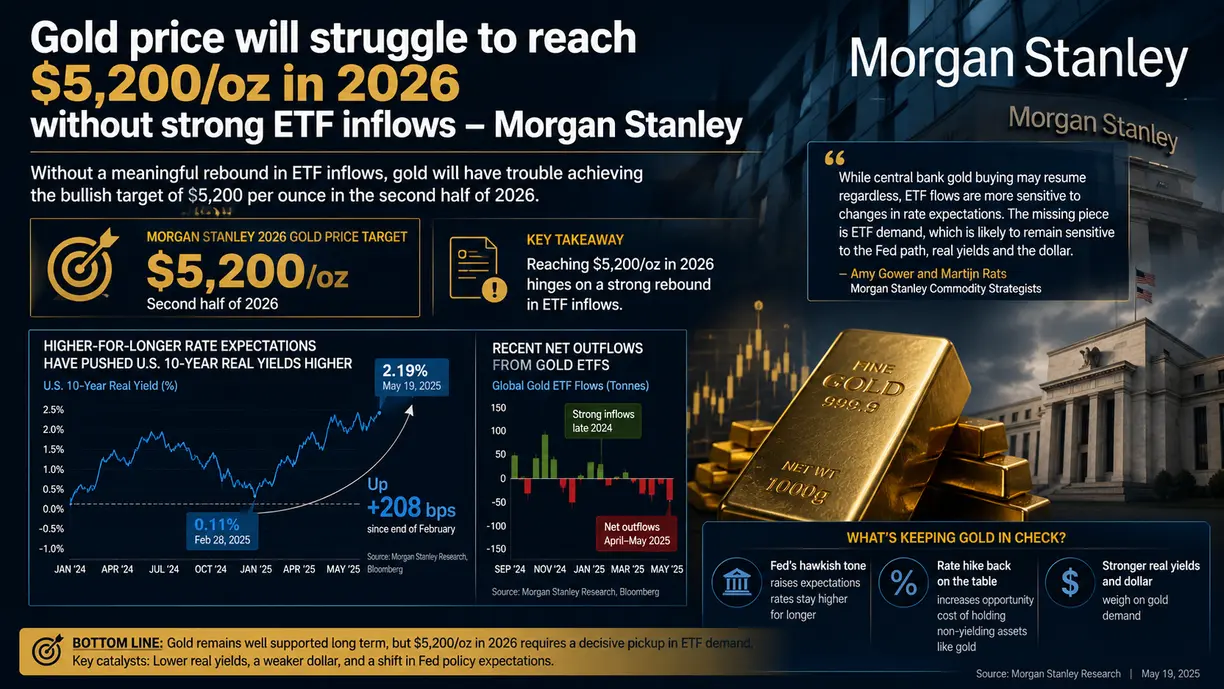
(Kitco News) – Without a meaningful rebound in ETF inflows, gold will have trouble achieving the bullish target of $5,200 per ounce in the second half of 2026, according to commodity strategists at Morgan Stanley.
“While central bank gold buying may resume regardless, ETF flows are more sensitive to changes in rate expectations,” analysts Amy Gower and Martijn Rats wrote in a Monday research note. “The missing piece is ETF demand, which is likely to remain sensitive to the Fed path, real yields and the dollar.”
The investment bank remains bullish on the precious metal’s long-term outlook, as they expect easing tensions in the Middle East and lower oil prices will help reduce inflation expectations. However, the analysts cautioned that Federal Reserve’s hawkish tone at Wednesday’s meeting has now raised expectations that interest rates could stay higher for longer, with a rate hike now back on the table, which increases the opportunity cost of holding non-yielding assets such as gold.
Morgan Stanley shared data which showed that higher-for-longer rate expectations have driven U.S. 10-year real yields well above February’s levels, prompting recent net outflows from gold ETFs and contributing to gold’s price slide.

On May 6, Gower said that she was seeing renewed momentum in the gold market as she reiterated her call for gold prices to end the year around $5,200 an ounce, adding that she is not surprised the yellow metal has struggled in recent months despite heightened geopolitical uncertainty from the ongoing war in Iran.
“With the conflict triggering an energy supply shock that has reduced hopes for lower U.S. interest rates, it is not surprising that gold has struggled to work as a safe haven this time,” Gower said. “Gold’s sensitivity to monetary policy has taken over as the key price driver. This has overshadowed its safe-haven status and reduced its effectiveness as a hedge against both geopolitical and inflation risks. Gold prices reflect not just the impact of a particular event but, more importantly, the policy response that follows.”
High oil prices, driving inflation pressures, are forcing the Federal Reserve to reevaluate its easing policy stance and, as a result, markets have started to price out rate cuts this year. At the time, Morgan Stanley was still betting on at least one rate cut this year, which would support higher gold prices.
“Gold is likely to remain sensitive to real yields, but we see room for further upside,” Gower said.
In May, Morgan Stanley saw one rate cut in January followed by another rate cut in March 2027.
“This should benefit gold, with ETF purchasing decisions particularly sensitive to policy signals and gold now realigning with real rates,” she said.
Gower added that the longer the Iran conflict continues, the greater the risks are for gold.
“Gold prices may suffer if markets begin to anticipate prolonged rate holds or even hikes,” Gower warned. “At the same time, upside in a resolution scenario could be limited, as already elevated prices may constrain demand from ETFs, central banks and consumers.”
