
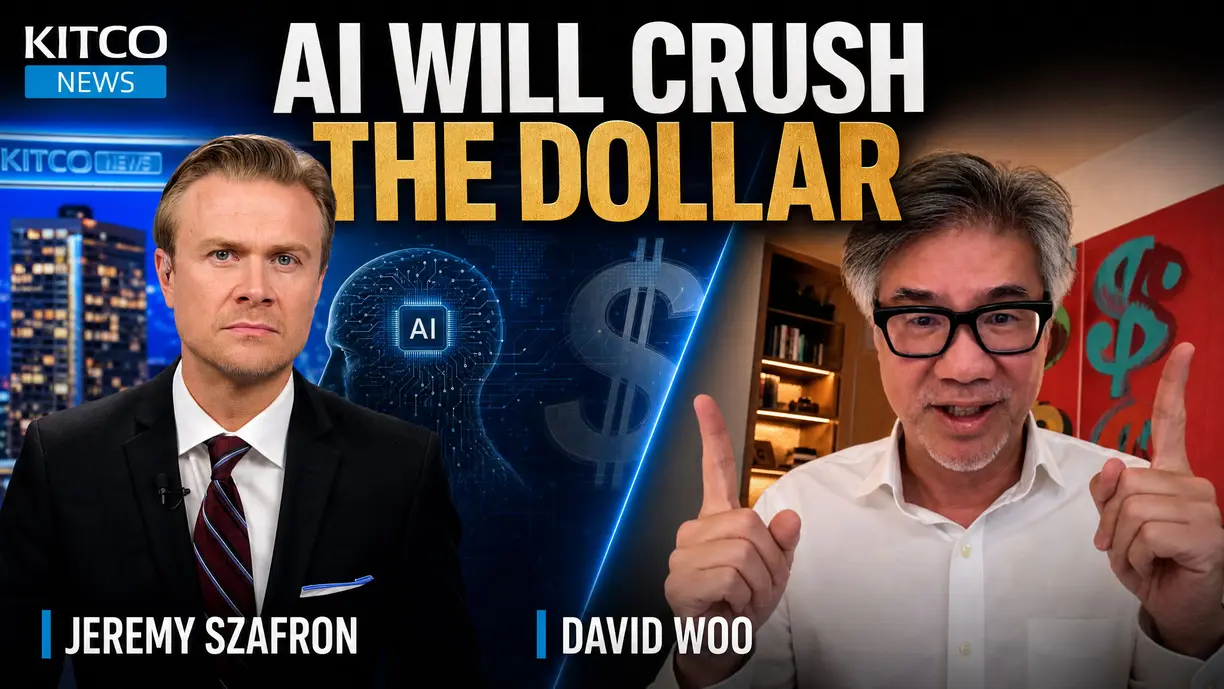
(Kitco News) - As Wall Street cheered an interim deal between Washington and Tehran to reopen the Strait of Hormuz, sending oil to a two-month low and lifting stocks, one of the most respected voices in global macro used his appearance on Kitco News to argue that investors are celebrating the wrong story, and missing the one that actually threatens the dollar.
David Woo, who spent two decades running global rates and currency research at Bank of America before leaving to write fiction, did not soften the message. He called the agreement a strategic loss of historic proportions and warned that the foundation under the rallying market, the artificial intelligence boom, is far more fragile than the price action suggests.
"This is probably the biggest single defeat by the United States since the Vietnam War," Woo said, describing the deal as "a complete capitulation" whose consequences run "way beyond" what markets currently grasp. The damage, in his view, is to credibility itself. Seen from abroad, he argued, the takeaway is that "America's a paper tiger." More than a single negotiation, he framed it as an inflection point: "Today we should be mourning perhaps the passage of US hegemony."
Gold did not wait for the argument. The metal climbed for a third straight session on Monday, settling near 4,339 dollars an ounce, up roughly 2.8 percent on the day even as oil fell and equities advanced, an unusual pairing in which the classic safe haven rallied alongside risk assets. Bullion remains down about 5 percent over the past month, the correction Woo was asked to explain, but it is still up more than 28 percent over the past year. The metal set 53 record highs in 2025 and total annual demand topped 5,000 tonnes for the first time on record, according to the World Gold Council, before pulling back from a January peak near 5,400 dollars to current levels.
A different explanation for the gold correction
Asked what asset would first register a strategic American defeat, Woo pointed without hesitation to gold, and called the recent pullback a buying opportunity for those willing to hold.
"Any time you get a chance to buy gold around 4,000 dollars an ounce, I think that's attractive," he said, while cautioning that the position is for long-term investors and that a rebound in oil and real yields could stall the rally.
His explanation for why gold fell this spring is one not widely circulated. Woo suggested the selling came from Gulf oil producers who, blocked from exporting crude during the conflict, needed cash to cover their bills and could not sell US Treasuries without drawing scrutiny from Washington. "The only thing left to sell was, of course, gold," he said, casting the decline as a forced liquidation rather than a verdict on the metal.
Whatever the cause of the spring selling, the longer trend points the other way. Central banks bought 863 tonnes of gold in 2025, the fourth straight year of official-sector demand running far above the 2010 to 2021 average of roughly 473 tonnes a year, according to the World Gold Council, and the buying carried into 2026 with an estimated 244 tonnes in the first quarter. Late last year, gold overtook US Treasuries to become the world's largest reserve asset by value, perhaps the clearest market signal yet of the shift away from dollar primacy that Woo described.
'If this AI bubble were to burst, the dollar's toast'
The heart of Woo's thesis is that the dollar's strength is borrowed from the AI trade, and that the loan is being called. The greenback is firm, he argued, largely because the world must buy dollars to access American AI, from Nvidia chips to the models built by OpenAI and Anthropic. Remove that, and the support disappears.
"If this AI bubble were to burst, the dollar's toast," Woo said.
He sees the bubble squeezed from two sides at once. At the high end, Washington is increasingly willing to restrict the most powerful models on national security grounds, a dynamic underscored this month by the government's move to pull back a frontier Anthropic release. At the low end, cheaper Chinese competitors are taking share, with some US businesses already shifting AI spending toward lower-cost alternatives. Caught between regulation above and commoditization below, Woo questioned how the marquee AI companies preparing to go public this year can justify their valuations, and warned that the entire structure rests on their continued spending. He pointed to a detail he says the market is ignoring: combined capital expenditure from the five largest hyperscalers, he said, fell in the first quarter, a slowdown he believes could pull the trade lower in the second half of the year.
The math behind gold's recent weakness, he explained, is real yields. Because gold pays no interest and competes with inflation-protected Treasuries, it trades against real yields rather than headline inflation. The roughly three-month surge in real yields, which pushed the 30-year Treasury yield above 5 percent, raised the cost of holding bullion. Crucially, Woo argued that the surge required two forces together, the war-driven oil spike and the AI-fueled jump in demand. With oil now retreating, one of those legs is giving way. "For gold to stabilize or even rally, you just need one of two things. You either need lower oil price or lower AI," he said. Monday's near 3 percent gold rally on the oil selloff, he noted, was that logic playing out in real time.
Should the AI trade unravel outright, his outlook turns far more dramatic: a recession, rates returning to zero, and "gold is gonna be trading at 10,000 dollars."

A debt backdrop that is getting heavier
Woo's broader warning lands against a fiscal picture that has deteriorated even since the figures most investors carry in their heads. He referenced a federal debt "north of 37 trillion," the level reported by the Treasury in August 2025, but the debt has since pushed to roughly 39 trillion as of spring 2026, according to Treasury data, having added a trillion dollars in a matter of months. Net interest payments are projected to exceed 1 trillion dollars in fiscal 2026, nearly triple what the government paid in 2020 and now a larger line item than either Medicare or national defense, according to figures from the Congressional Budget Office. It is the kind of arithmetic, Woo argued, that a strategic defeat abroad only makes worse, since he expects it to trigger still more defense spending and still more borrowing.
The book, and the bigger machine
Woo tied the macro picture back to his novel, "Merry-Go-Round Broke Down," which Paul Tudor Jones has championed and which Woo said has drawn multiple Hollywood offers, with a second season now in development. Asked whether AI had become the new unstoppable system at the center of his story, he agreed without qualification: "In a way it is, absolutely."
The throughline, he explained, runs from economics to politics to geopolitics. Globalization produced the displaced worker at the heart of his book. That displacement became a political force, which in turn hardened into the US-China rivalry now driving markets. It is why, he argued, the next crisis may look nothing like the last one. Where 2008 delivered a financial collapse, Woo warned the next rupture could be geopolitical, with great-power competition increasingly extending into space.
His closing advice for ordinary savers was strikingly plain for a man with such a sweeping thesis: the goal in the years ahead is simply not to lose money, and the discipline that protects you is buying when others sell. On gold, he was direct. If you have not sold, he said, he would not be rushing to now.
Woo goes considerably deeper in the full interview above, including his read on new Federal Reserve Chair Kevin Warsh ahead of Wednesday's decision, why he believes luck drives more of Wall Street success than anyone will admit, and the specific scenario he says could send gold to 10,000 dollars. Watch the complete interview, and subscribe to Kitco News so our breakdown of the Fed decision lands in your feed the moment it breaks on Wednesday.