
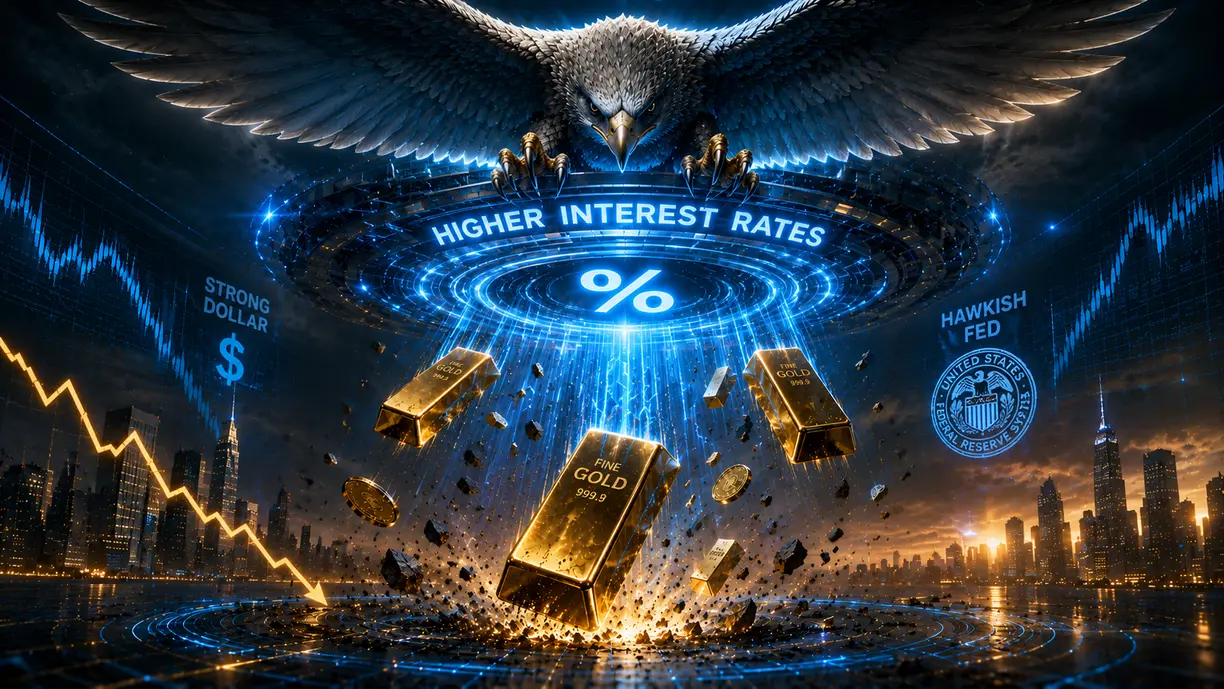
(Kitco News) - The gold market is trying to find its footing after the Federal Reserve left interest rates unchanged but signaled a hawkish tilt, showing support for at least one potential rate hike by the end of the year.
The precious metal suffered further losses as newly minted Fed Chair Kevin Warsh highlighted the central bank’s commitment to controlling inflation. By the end of his press conference, gold prices were trading at their session lows, down more than 1% on the day.
Warsh’s comments caused gold prices to give up the gains they had made over the previous two days.
At the start of the Asian trading session, gold was struggling to find momentum. Spot gold last traded at $4,267.30 an ounce, up 0.27% on the day.
Warsh struck a hawkish tone from the beginning of his press conference, saying that price stability will be the central bank’s “North Star.”
“The way to get monetary policy right is to deliver on the remit that Congress gave us to deliver on price stability,” he said.
‘It was clear from the policy statement, the Dot Plot, and the press conference that the Fed’s decision-making calculus has shifted from “should we cut” at 2026’s start to “should we hike” at mid-year,” said Bill Adams, Chief U.S. Economist, Fifth Third Commercial Bank
Warsh also announced that he will create five task forces to examine different aspects of the central bank’s monetary policy process: Fed communication, the Fed's balance sheet, the use of and reliance on existing data sources, productivity and jobs in an era of transformation, and the Fed's inflation framework.
"What we've given markets is a new chapter for the central bank, some fresh thinking," he said.
Chris Zaccarelli, Chief Investment Officer for Northlight Asset Management, said the task forces will set the stage for far-reaching changes in the future.
“By taking more time and attempting to build consensus, Kevin Warsh can begin the process of reducing the Fed’s current high level of transparency, revising its inflation framework, and scaling back its extensive use of the balance sheet,” he said in a note. “Very few people have mentioned the idea of significantly reducing the Fed's balance sheet — de facto tightening — while simultaneously cutting interest rates, because at face value it seems contradictory. But if your goal is to reduce short-term interest rates — or keep them unchanged in the face of compelling reasons to raise them, such as much-too-high inflation — while slowing financial markets so they don’t overheat, you can simultaneously slam on the brakes (significantly reduce the balance sheet) and slowly press the gas pedal (lower interest rates gradually) and achieve both goals in a less obvious way.”
