
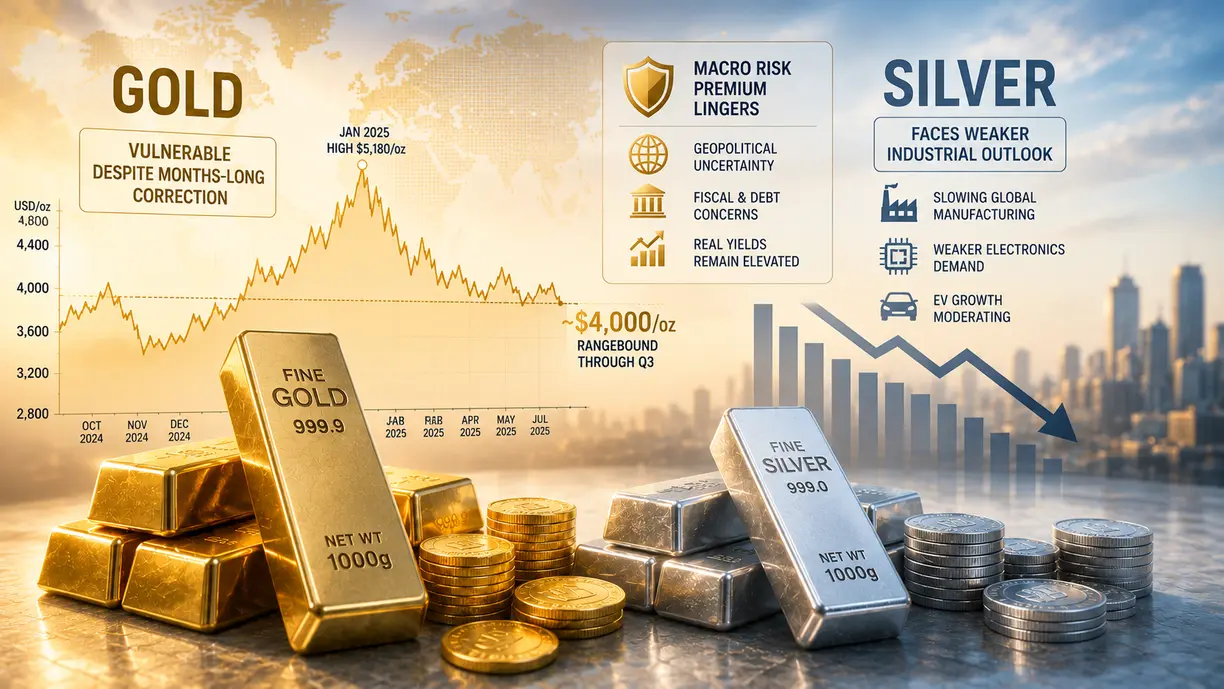
(Kitco News) - The gold market remains stuck in neutral around $4,000 an ounce, and one international brokerage firm expects prices to remain rangebound through the third quarter, even as resilient economic growth and higher real yields continue to pose downside risks.
In its latest quarterly metals research report, commodity analysts at Sucden Financial said that despite gold's nearly 30% drop from its January highs, valuations remain elevated relative to traditional macro drivers.
"Even after the correction, gold continues to trade above levels that would typically be implied by real yields and the U.S. dollar," the analysts said. "This suggests that much of the geopolitical and macro risk premium accumulated earlier in the year has not yet been fully removed."
However, the analysts see limited downside through the third quarter.
"We expect gold to remain supported into late September, but largely rangebound. We therefore see gold consolidating within a broad $3,950-$4,300/oz range through late September. Dips towards the lower end of the range should continue to attract buying interest, while gains above $4,200/oz are likely to struggle for follow-through until the Fed's policy becomes dovish," the analysts said.
According to Sucden, the primary headwinds facing gold remain firmly in place. Sticky inflation has forced major central banks, particularly the Federal Reserve, to maintain restrictive monetary policy, pushing real yields higher and increasing the opportunity cost of holding non-yielding assets such as gold.
While the correction has improved valuations, the report argues that prices still appear expensive when measured against the macro backdrop.
"The disconnect between gold prices and traditional valuation metrics has narrowed, but it has not disappeared," the analysts said, adding that additional downside cannot be ruled out if the market continues to unwind the safe-haven premium built up earlier this year.
Although the near-term outlook remains challenging, Sucden does not see the correction as the end of gold's longer-term bull market.
The firm noted that structural drivers—including persistent central bank demand, ongoing reserve diversification, elevated government debt levels, and longer-term geopolitical uncertainty—continue to provide an important foundation for the precious metal.
The report also highlighted that investor positioning remains relatively resilient despite the correction, suggesting that additional liquidation could occur if macroeconomic conditions continue to improve or expectations for monetary easing are pushed further into the future.
Silver faces mixed outlook
Sucden said silver continues to face a more complicated outlook than gold because it remains heavily influenced by both monetary and industrial demand.
Although silver has corrected sharply alongside gold, the analysts warned that weakening industrial activity presents an additional headwind.
Sucden pointed to slowing manufacturing activity and softer industrial demand expectations as factors likely to limit silver's upside in the near term, even if investment demand stabilizes.
"Silver should remain more volatile than gold but with no clear trend. We therefore see silver consolidating within a broad $56-66/oz range through late September. Dips towards the mid-$50s should attract buying interest, while the current macro environment is unlikely to support a sustained move above the top of the range," the analysts said.
At the same time, the analysts said silver should continue to benefit from many of the same long-term structural themes supporting gold, including demand for hard assets and continued investor interest in precious metals as portfolio diversifiers.
