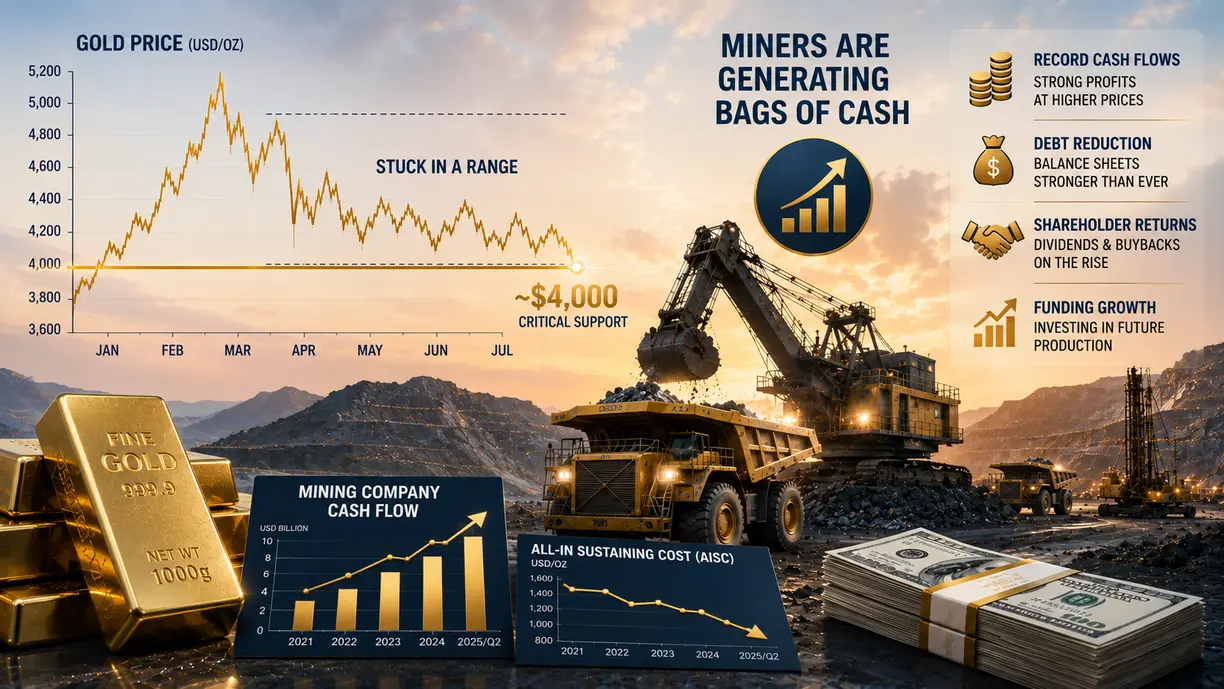
(Kitco News) - Gold's months-long correction appears to be nearing its end, but prices continue to consolidate near critical support around $4,000 an ounce. The market remains caught between gold's traditional role as a safe-haven asset and the pressure of rising real yields.
Persistent inflation has reinforced expectations that interest rates could remain elevated for longer, increasing the opportunity cost of holding gold. This has weighed on investment demand and dampened enthusiasm for the metal itself.
Yet investors focused solely on the gold price may be missing a more compelling story unfolding in the mining sector.
While gold has struggled to regain momentum, second-quarter earnings have highlighted just how dramatically the industry's fundamentals have improved. Despite gold’s 30% drop from its first-quarter highs, miners still benefited from an average gold price of more than $4,400 an ounce during the second quarter. More importantly, investors should be paying attention to what companies are doing with the cash they are generating.
Last week, Bank of America maintained a constructive view on gold equities even as it lowered its 2026 gold price forecast. Earnings season suggests that view may be increasingly supported by company fundamentals rather than expectations for higher metal prices.
Many of the industry's leading producers are generating record free cash flow, strengthening their balance sheets, returning money to shareholders, and continuing to invest in long-life projects that can support future production growth.
Agnico Eagle delivered a record quarter, generating $1.335 billion in free cash flow while returning a record $625 million to shareholders. At the same time, the company continues to advance major growth projects, including Odyssey, Hope Bay, and Upper Beaver.
Kinross reported more than $725 million in free cash flow, increased its net cash position to $1.9 billion, and returned roughly 40% of its free cash flow to shareholders. The company also highlighted the long-term potential of its Lobo-Marte project, which could become one of the sector's lowest-cost operations.
Even Alamos Gold, despite reducing guidance following seismic issues at Young-Davidson, generated $143.5 million in free cash flow while continuing to fund its Island Gold District expansion internally.
What's becoming harder to ignore is that many gold miners are no longer operating as simple leveraged bets on the gold price. After years of focusing on costs, balance sheets, and capital discipline, a growing number are producing the kind of consistent cash flow that investors typically reward in other sectors.
Meanwhile, investors remain heavily focused on AI-linked stocks, many of which are trading at elevated valuations. That enthusiasm may be warranted, but it has also drawn attention away from areas of the market where valuations remain comparatively attractive.
For investors looking beyond momentum trades, gold miners increasingly stand out as a sector offering both value and improving fundamentals. That's a combination that has become surprisingly rare in today's market.

Neils Christensen
Neils Christensen has a diploma in journalism from Lethbridge College and has more than a decade of reporting experience working for news organizations throughout Canada. His experiences include covering territorial and federal politics in Nunavut, Canada. He has worked exclusively within the financial sector since 2007, when he started with the Canadian Economic Press. Neils can be contacted at: 1 866 925 4826 ext. 1526 nchristensen at kitco.com @KitcoNewsNOW

Disclaimer: The views expressed in this article are those of the author and may not reflect those of Kitco Metals Inc. The author has made every effort to ensure accuracy of information provided; however, neither Kitco Metals Inc. nor the author can guarantee such accuracy. This article is strictly for informational purposes only. It is not a solicitation to make any exchange in commodities, securities or other financial instruments. Kitco Metals Inc. and the author of this article do not accept culpability for losses and/ or damages arising from the use of this publication.