
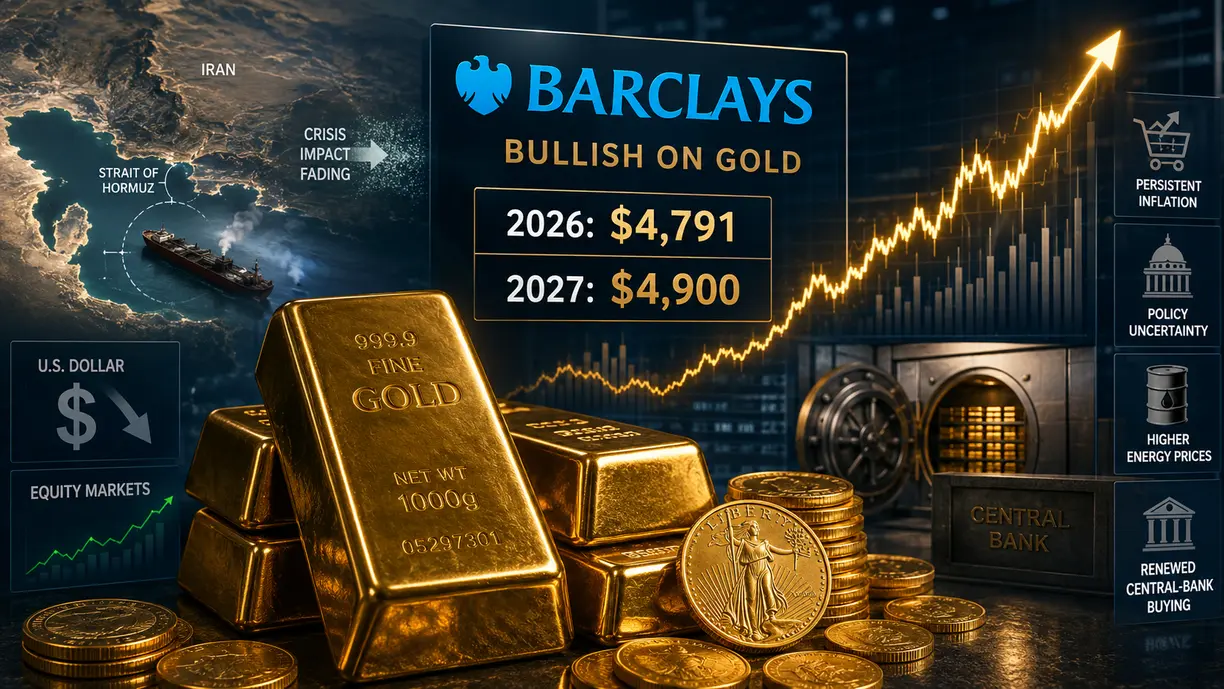
(Kitco News) – Gold’s 26% decline during the Iran conflict came from a boost to the dollar, yields and equities which overwhelmed the yellow metal's safe-haven appeal, but persistent inflation, policy uncertainty and central bank demand remain intact, and gold prices will still reach nearly $4,800 in 2026 and $4,900 in 2027, according to Barclays.
In a research note published Monday, the UK banking giant’s cross-asset research team led by Lefteris Farmakis and Themistoklis Fiotakis said gold’s three-month selloff was driven by the stronger U.S. dollar, white-hot equity markets absorbing all the available risk capital, and the unwinding of leveraged gold positions, with Russian and Turkish central bank gold sales also contributing to the weakness.
The analysts said gold’s slide from its January peak to its June trough reflected a normalization of real interest rates, markets pricing out Fed rate cuts this year, and the short-term appeal of rising stocks detracting from gold’s investment appeal.

The Barclays team calculated that the rise in the dollar index and the 10% S&P 500 rally accounted for 10% of the gold price decline, with the remainder coming from position unwinding in the metals markets.
The analysts said these factors are temporary, however, and that gold’s structural drivers — persistent inflation, policy uncertainty and continued reserve diversification — are still intact, and they will reassert themselves as the geopolitical stress related to the Hormuz crisis dissipates. They characterized these drivers as “slow-moving variables whose influence accumulates over time,” which is why they were ill-suited to support gold prices during the short-term shock of the Iranian crisis.
Barclays calculated that every percentage-point increase in inflation gives gold a 5% uplift, and they believe the inflationary impulse of the Iran energy shock will be supportive.
The bank estimates gold’s fair value price currently sits at $4,150 per ounce, and they expect a rebound now that the Iran conflict appears to be winding down.
The Barclays team said they now anticipate a reassertion of the dollar’s downward trend, a return to consistent central bank buying and sustained upward pressure on inflation from higher energy prices.

Barclays said they are maintaining their 2026 and 2027 gold price forecasts at $4,791 and $4,900 per ounce, but warned that there may still be some short-term mark-to-market downside. The analysts also recommended exposure to gold mining stocks, including Endeavour, Hochschild, Fresnillo, Newmont and Agnico Eagle.
“Recent price gyrations notwithstanding, if there is a period when gold ought to be trading at a premium, it is now,” they said.
