
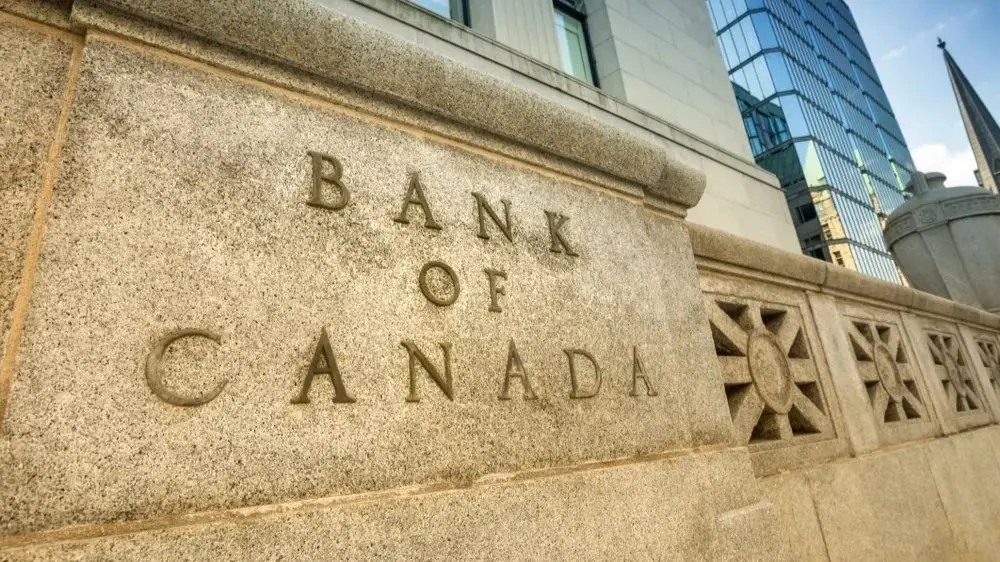
(Kitco News) - The Bank of Canada (BoC) maintained its key overnight rate at 2.25% on Wednesday, as expected, with the bank rate staying at 2.50% and the deposit rate remaining at 2.20%.
The BoC said economic activity in Canada has been weak and uncertainty about U.S. trade policy persists, while the conflict in the Middle East is ongoing and oil prices remain elevated, but they reiterated their commitment to prevent higher energy prices from becoming persistent inflation.
The Canadian dollar rose to session highs in the minutes after the announcement, but pulled back slightly in the minutes afterward. USD/CAD last traded at 1.3616 per U.S. dollar, down 0.24% on the session.

Gold fell to a session low of $5,755.11 per ounce in Canadian dollar terms in the minutes before the announcement, and the yellow metal continued to trade not far from its lows afterward. XAU/CAD last traded at $5,818.09 per ounce for a loss of 2.09% on the daily chart.

In its announcement, the Bank of Canada noted that the conflict in the Middle East is now in its fourth month. “The resulting increases in energy prices and disruptions in global supply chains are weighing on global economic growth and pushing up inflation,” they wrote. “At the same time, the US administration continues to propose new tariffs and trade policy uncertainty remains elevated.”
The BoC said Canadian financial conditions have loosened since the April Monetary Policy Report. “Global equity markets have been buoyant and bond yields remain volatile,” they said. “The Canadian dollar has weakened against the US dollar and other currencies.”
They noted that Canadian GDP fell by 0.1% in Q1 while consumer spending grew 1.4% but government spending declined. “Housing activity also declined and business investment remained weak,” they said. “Exports fell while imports rose strongly as inventories were rebuilt. Employment was up in May, but looking through monthly volatility, employment in Canada is little changed since the start of the year. The unemployment rate continues to fluctuate in the 6 ½%-7% range with the most recent reading at 6.6% in May.”
The BoC said the latest data suggest that growth will resume in the second quarter but the economy is still expected to remain in excess supply.
Turning to inflation, the BoC said “there has been limited evidence of broad-based pass-through of higher energy prices to other consumer prices,” but with global oil prices still roughly $10 a barrel above the April MPR assumptions, “total inflation is expected to hover around 3% in the near term before easing gradually towards 2%.”
“Economic activity in Canada has been weak and uncertainty about US trade policy persists,” they concluded. “The conflict in the Middle East is ongoing and oil prices remain elevated. Governing Council is continuing to look through the war’s near-term impact on headline inflation, but will not let higher energy prices become persistent inflation.”
